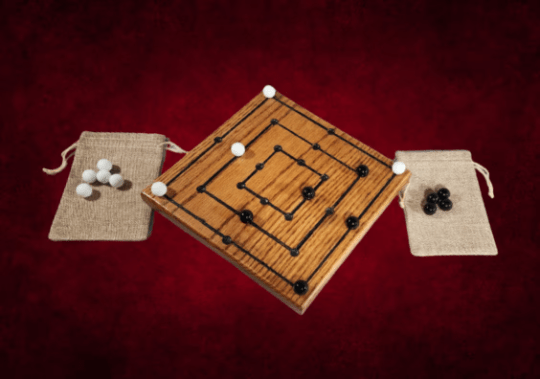
Nine Men’s Morris from One Grumpy Sailor
History: Nine Men’s Morris is a historic strategy board game that dates back to ancient times. Its exact origins are uncertain, but it is believed to have been played as early as the Roman Empire. The game has been known by various names throughout history, including “Mill,” “Merels,” “Mühle” (in German-speaking regions), and “Morabaraba” (in South Africa). It has enjoyed popularity in Europe, the Middle East, and beyond.
Countries of Traditional Play: Nine Men’s Morris has been played in numerous countries and regions throughout history, with variations in rules and board designs. It has been particularly popular in Europe, including England, France, and Germany, where it is known by different names.
Alternate Names: Nine Men’s Morris is known by several alternate names, depending on the region and language. Some common names include “Mill,” “Merels,” “Mühle” (German), “Morabaraba” (South Africa), and “Jeopardy” (among the Blackfeet Native American tribe).
Basic Rules of Nine Men’s Morris: Nine Men’s Morris is a two-player strategy game played on a grid or board with three concentric squares, each consisting of eight points where players place their pieces.
Objective: The objective of Nine Men’s Morris is to form “mills,” which are horizontal or vertical rows of three of your own pieces. Forming a mill allows you to remove one of your opponent’s pieces from the board. The goal is to reduce your opponent’s pieces to two, making them unable to form mills.
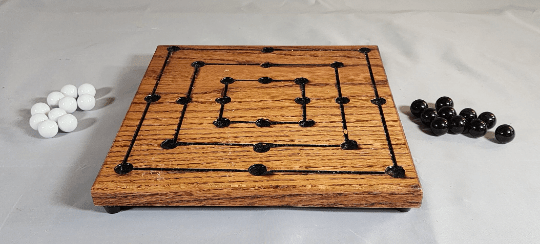
Equipment:
- A Nine Men’s Morris board with three concentric squares, each containing eight points.
- 18 game pieces, 9 for each player (traditionally one player uses white pieces, and the other uses black).
Setup:
- Place the Nine Men’s Morris board on a flat surface.
- Each player takes their 9 pieces and alternates placing them on the board’s points.
- Players take turns placing their pieces until all 18 pieces have been placed on the board.
Gameplay:
- Players take turns moving one of their pieces to an adjacent empty point along the marked lines on the board.
- If a player forms a mill (three of their pieces in a row horizontally or vertically), they can remove one of their opponent’s pieces from the board.
- Players must move their pieces strategically to both defend their positions and try to form mills.
- Once a player has only three pieces left, they can “fly” to any empty point on the board with each move, making it more challenging for their opponent.
- The game continues until one player is reduced to two pieces, and they are unable to form a mill or make a legal move. The other player wins.
Alternate Sets of Rules: While the basic rules of Nine Men’s Morris remain consistent, there are regional and historical variations of the game. Some alternate sets of rules include:
- Double Mill Rules: In this version, a player who forms a mill can remove two of their opponent’s pieces instead of just one.
- Swap Rules: Some variations allow players to swap the positions of their pieces instead of making normal moves, creating more strategic possibilities.
- Nine Holes Morris: This variant uses a larger board with nine points per square, making the game more challenging and requiring longer rows to form a mill.
- Three Men’s Morris: A simplified version of the game, played with fewer pieces and a smaller board, for quicker matches.
These alternate sets of rules and variants can provide players with different challenges and strategies while preserving the essence of Nine Men’s Morris as a classic and timeless board game.
Top of Form
 One Grumpy Sailor