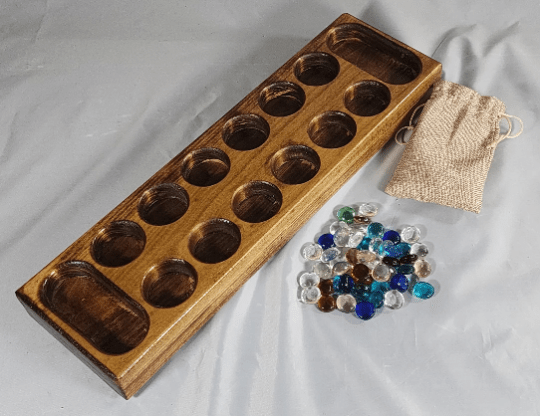
History: Mancala is an ancient board game with a history spanning thousands of years. Its origins can be traced back to Africa, with evidence of early versions found in archaeological sites dating back to the 6th century BC. The name “Mancala” is thought to have been derived from the Arabic word “naqala,” which means “to move.”
Mancala has been enjoyed in various forms across many cultures and regions. Different countries have their own names for the game, including “Oware” in Ghana, “Bao” in East Africa, “Congkak” in Malaysia and Indonesia, and “Sungka” in the Philippines. Despite these diverse names and rule variations, the core concept of moving and capturing pieces of glass in pits remains consistent.
Basic Rules of Mancala: Mancala is traditionally played by two players. Here are the basic rules:
Objective: The objective of Mancala is to capture more pieces of glass than your opponent.
Equipment:
- A Mancala board with two rows of pits (usually 6 pits per row) and two larger pits (the Mancalas) at each end.
- 48 pieces of glass (typically 4 pieces of glass per pit).
Setup:
- Place the board horizontally between the two players, with the Mancalas on each player’s right-hand side.
- Fill each of the 12 small pits with 4 pieces of glass .

Gameplay:
- Players take turns in clockwise order.
- On a player’s turn, they choose one of their pits that contains pieces of glass and distribute the pieces of glass in a counterclockwise direction, placing one seed in each pit, including their Mancala, but skipping their opponent’s Mancala.
- If the last seed a player places lands in their Mancala, they get another turn.
- If the last piece of glass lands in an empty pit on their side, and the opposite pit on the opponent’s side has pieces of glass, the player captures all the pieces of glass in both pits and adds them to their Mancala.
- The game continues until one player’s row of pits is empty. The player who still has pieces of glass in their pits captures all remaining pieces of glass in their pits and adds them to their Mancala.
- The player with the most pieces of glass in their Mancala wins the game.
Alternate Sets of Rules:
While the basic rules of Mancala are consistent, regional and cultural variations have led to several alternate sets of rules. Here are a few examples:
- Oware (Ghana): Oware is a popular variant of Mancala played in Ghana and other West African countries. It has specific rules for capturing pieces of glass and sowing, making it a more strategic game.
- Bao (East Africa): Bao is a complex variant of Mancala played in East Africa, especially in countries like Tanzania and Kenya. It features a 4×8 board and introduces specialized rules for capturing and moving pieces of glass, making it a challenging game of strategy.
- Congkak (Malaysia and Indonesia): Congkak is a variant of Mancala played in Southeast Asia. It uses a long, narrow board with special pits for capturing pieces of glass. Players follow unique rules for moving and capturing pieces of glass, adding a layer of complexity to the game.
- Sungka (Philippines): Sungka is a Filipino variant of Mancala played on a 7×7 board. It has different pits and more intricate rules for capturing and sowing pieces of glass, creating a distinct gameplay experience.
These regional variations of Mancala provide players with diverse and culturally rich gaming experiences while still embracing the fundamental principles of the game: sowing and capturing pieces of glass to outmaneuver your opponent.
 One Grumpy Sailor